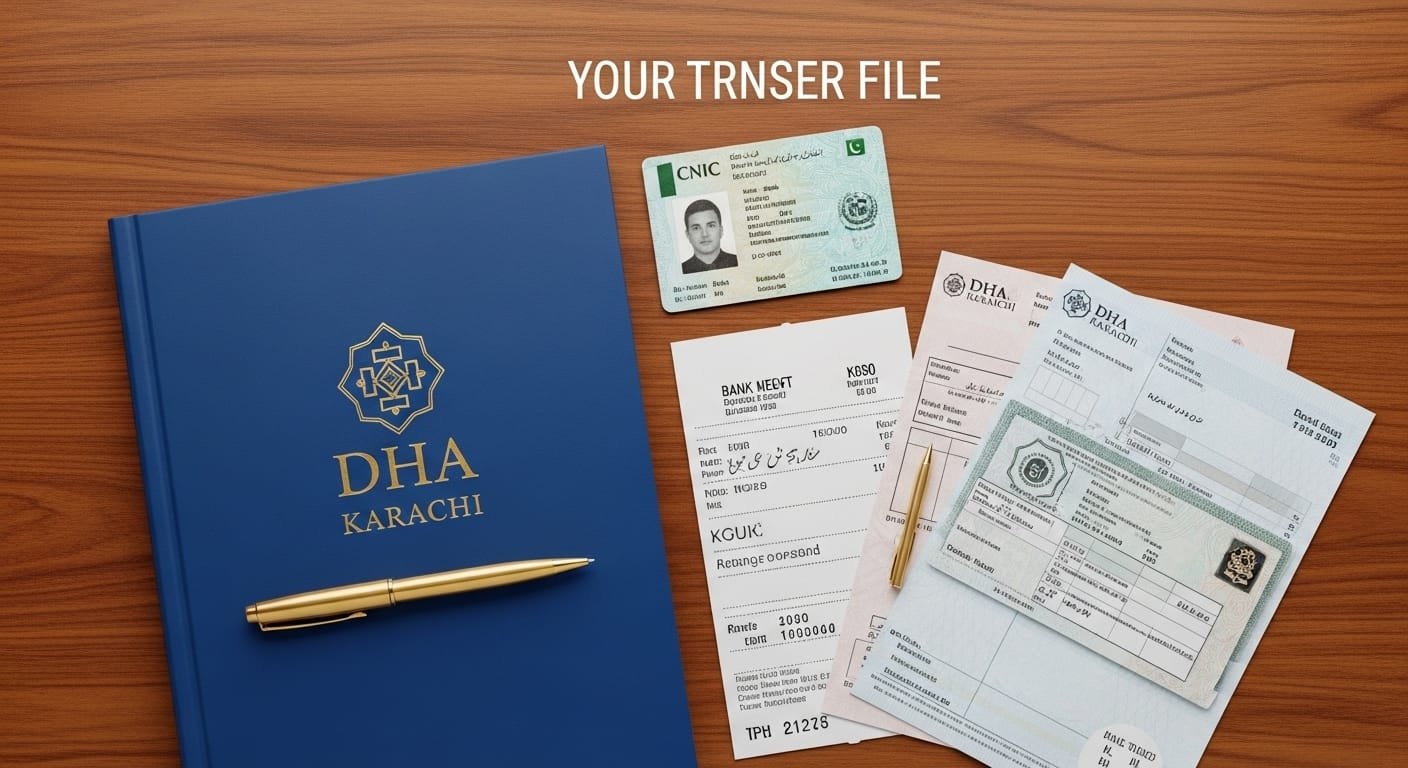
Updated September 2026. If you are selling property in DHA Karachi, the safest approach is to separate three things: documents required to sell property in DHA Karachi, documents needed only in special cases, and papers that are commercially useful but are not part of the standard DHA transfer checklist.
Quick Answer: What Documents Are Required to Sell Property in DHA Karachi?
For a normal DHA Karachi transfer, the published DHA checklist starts with the seller’s covering letter, seller affidavit, applicable original DHA title/allotment/transfer documents, identity documents, valid DHA membership evidence and any case-specific consent or NOC. The seller must also produce original identity documents before the DHA designated officer for Sign Before and biometric/CNIC authentication.
Do not rely on a generic internet checklist. A house, leased property, co-owned property, corporate property, mortgaged property, legal-heir case or special project can require additional documents.
This guide explains what a seller should prepare before accepting a serious offer. For the process after the file is ready, see our DHA Karachi Transfer Process 2026. If you are still deciding when to list, also read Best Time to Sell Your House in DHA Karachi.
Official Normal-Transfer Checklist: Seller-Side Essentials
DHA Karachi’s published Transfer of Plot – Normal instruction slip is the correct starting point. In practical seller language, the core file includes the following.
1. Seller’s Covering Letter for Transfer
DHA’s normal-transfer instructions require a covering letter from the seller requesting transfer. The prescribed specimen leaves space for additional seller signatures used during the transfer formalities.
2. Seller’s Affidavit
The normal-transfer checklist requires the prescribed seller affidavit, attested as instructed by DHA. For an affidavit executed in Pakistan, DHA’s instruction refers to attestation by the appropriate Oath Commissioner/Notary Public; documents executed abroad have separate attestation requirements.
3. Original DHA Title / Ownership Documents
This is one of the most important parts of the file. DHA requires the applicable original letters issued by DHA, such as the original Allotment Order, Transfer Order, Division Order, Adjustment Letter, Amalgamation Letter or Intimation Letter, depending on the property’s history.
If an original title document has been lost, do not assume a photocopy will be accepted. DHA’s normal-transfer instruction says the owner should apply for a Certified True Copy (CTC) in the case of a lost title document.
4. CNIC / NICOP / POC / Passport Documentation
The transfer file requires identity-document copies in the form prescribed by DHA. More importantly, the seller must produce the original CNIC/POC/passport before the DHA designated officer during the Sign Before stage.
DHA’s published transfer process states that seller identification can involve CNIC verification, finger scan/biometric authentication, physical identification, membership records and other available means.
5. Valid DHA Membership Evidence
DHA states that valid membership is required for the parties involved in a normal transfer. Its instruction slip asks for the seller/buyer valid membership card or the relevant receipt copy.
Documents That Depend on the Property or Ownership Situation
This is where generic “15-document” lists often become inaccurate. The following are case-specific, not universal requirements for every DHA Karachi sale.
| Situation | Possible additional requirement |
|---|---|
| Co-owned / co-sharer property | Consent letter from co-sharer(s), with the details required by DHA |
| Armed Forces / service-benefit allotment | Relevant GHQ/authority NOC where applicable |
| Corporate / company / trust property | Corporate NOC and entity/signatory documentation as applicable |
| Mortgaged property | Bank clearance / NOC before transfer can proceed |
| Property affected by GPA | GPA-related observations must be resolved; DHA states an active GPA must be revoked before transfer |
| Leased property | Lease-related requirements may apply; DHA states an ‘A’ Lease must be surrendered before transfer, subject to stated exceptions |
| Property under litigation/investigation | Transfer cannot proceed while the relevant encumbrance remains unresolved |
| Creek Vista / special project | Project-specific indemnity, tax-paid bill or NOC may be required |
| Phase VII Extension with construction | DHA’s normal-transfer instruction specifically mentions completion-plan certificate, seller undertaking and valid CBC tax-paid bill copy |
The safest practice is to identify the exact property category and ownership history before preparing the file. A normal plot transfer checklist should not be copied blindly onto every house, apartment or special-project transaction.
Are Utility Bills, Seller Photos and a Completion Certificate Always Mandatory?
No—not as a blanket rule in DHA’s published normal-transfer checklist. This distinction matters.
- Utility bills: useful for possession and buyer due diligence, and required in some special cases, but the normal-transfer instruction does not list “last three months of all utility bills” as a universal seller requirement.
- Seller passport-size photographs: the normal-transfer instruction specifically mentions a fresh attested photograph of the purchaser; seller identification/photo capture is handled during the DHA process. Do not present “2–4 seller photos” as a universal rule unless the current case instructions require them.
- Completion certificate: do not describe it as universally mandatory for every house transfer. DHA’s published normal-transfer instruction specifically identifies completion-plan documentation for certain constructed-property situations, including Phase VII Extension.
- Bank account / IBAN verification: banking details are sensible for safe payment arrangements, but they are not shown as a standard DHA normal-transfer document in the published instruction slip.
- Token / bayana agreement: commercially important between buyer and seller, but it is not the same thing as a DHA title-transfer document.
Overseas Seller: Can You Transfer DHA Property Through Power of Attorney?
This is an area where sellers should be particularly careful. DHA Karachi’s current FAQ states that a GPA holder cannot transfer the property on behalf of the owner and that seller presence for Sign Before/biometric authentication is required under its transfer procedure.
DHA also publishes procedures for situations where an owner cannot attend its office, including requesting a DHA designated officer to carry out Sign Before formalities at another approved location at the owner’s expense. Because overseas cases can involve attestation, identity and tax-status issues, confirm the arrangement with DHA before accepting a transaction timeline from the buyer.
For overseas tax treatment, FBR also maintains separate guidance for qualifying overseas Pakistanis holding NICOP/POC. Tax rules can change, so verify the current position at the time of transfer rather than relying on an old rate card.
Inherited Property and Legal-Heir Cases
An inherited property is not a normal seller-transfer file until the ownership record has been dealt with correctly. DHA publishes a separate legal-heirs procedure. Depending on the facts, this can involve the deceased owner’s death certificate, identity documents of legal heirs, original DHA documents, succession/heirship documentation, legal-heir membership requirements and other prescribed papers.
If the registered owner has died, do not market the property as though one family member can simply sign the normal seller documents. Resolve the legal-heir transfer position first and follow the current DHA instructions for that case.
Mortgage, GPA, Lease or Litigation: Clear the Observation Before You Promise Transfer
DHA’s current property-transaction FAQs are clear on several blockers: a property cannot be transferred without the required bank clearance where a mortgage NOC is involved; an existing GPA must be revoked before transfer; the relevant ‘A’ Lease surrender requirement applies subject to DHA’s stated exceptions; and property under investigation or litigation cannot be transferred while the issue remains.
For sellers, this means document readiness should be checked before taking a large non-refundable bayana. A high offer does not solve a transfer observation.
Seller Sign Before and Biometric Verification
After the transfer documents pass scrutiny, DHA’s published process requires the seller to complete the Sign Before stage before the designated officer. DHA describes this as seller authentication through biometric/CNIC verification, signature verification and physical identification procedures.
The seller’s original title document is also part of this process; DHA’s FAQ states that a property cannot be transferred without production of its title document.
Tax and Payment Papers: Keep Them Separate From the DHA Ownership Checklist
A property transaction can involve FBR advance tax, DHA transfer fees/dues and other applicable charges. These amounts and procedures can change. The seller should therefore confirm the current tax status, applicable PSID/payment requirements and DHA account statement/dues when the transaction is actually being processed.
Do not confuse a tax payment receipt with proof of title. Likewise, do not confuse a token receipt or bank transfer record with the DHA transfer order. Each document serves a different purpose.
DHA Karachi Seller Document Checklist Before You List
- Locate every original DHA title/ownership letter applicable to the property.
- Check your CNIC/NICOP/POC/passport validity and make sure DHA membership records are current.
- Confirm the exact ownership structure: sole owner, co-sharers, company, trust or legal heirs.
- Check for mortgage, GPA, lease, litigation or other observations before committing to a transfer date.
- Identify project-specific documents if the property is in a special development or constructed-property category.
- Review DHA dues and current transfer instructions rather than relying on an old photocopied checklist.
- Keep buyer-facing records ready—utility status, maintenance history and possession details—even where they are not part of the standard DHA transfer file.
- Confirm current FBR treatment before calculating the seller’s net proceeds.
Once the file is ready, your next steps are pricing and marketing. See How to Price Your House Correctly in DHA Karachi and Sell Property in DHA Karachi.
Selling a Property in DHA Karachi?
Before advertising the property aggressively, make sure the ownership and transfer file can support the deal. ApnaDHA can help you organise the selling process, understand current buyer demand and market the property to relevant DHA buyers.
Frequently Asked Questions
What are the main documents required to sell property in DHA Karachi?
For a normal transfer, start with the seller’s covering letter and affidavit, applicable original DHA title/ownership documents, identity documents and valid membership evidence. Additional consent letters, NOCs or project-specific papers may apply to the particular property.
Is the original DHA title document required for transfer?
Yes. DHA’s published FAQ states that the title document must be produced with the transfer documents. If a title document has been lost, DHA’s normal-transfer instructions direct the owner to apply for a Certified True Copy where applicable.
Can a Power of Attorney holder sell my DHA Karachi property for me?
DHA Karachi’s current FAQ says a GPA holder cannot execute the transfer and that owner presence/Sign Before authentication is required under the transfer process. Owners who cannot attend the DHA office should ask DHA about its approved Sign Before arrangements for their circumstances.
Are three months of utility bills mandatory for every DHA property sale?
They are useful for buyer due diligence and possession, but DHA’s published normal-transfer instruction does not list the last three months of all utility bills as a universal requirement for every normal transfer. Special property categories can have separate tax-bill or NOC requirements.
Is a completion certificate mandatory for every house sale in DHA Karachi?
Do not apply that statement universally. Constructed and leased properties can have additional requirements, and DHA’s normal-transfer instruction specifically identifies completion-plan documentation for certain cases. Confirm the exact requirement for the property being sold.
Can a mortgaged DHA property be transferred without the bank’s clearance?
No. DHA’s property-transaction FAQ states that where a bank NOC for mortgage has been issued, the property cannot be transferred without the required bank clearance.
What happens if an original DHA document is missing?
Do not wait until transfer day. DHA’s normal-transfer instruction provides for applying for a Certified True Copy when an applicable title document has been lost. Resolve the missing-document issue before promising a firm closing date.
Official Source and Important Note
This guide is based on DHA Karachi’s published transfer procedure and normal-transfer instructions available at the time of this September 2026 update. Requirements can change and special cases can carry additional documentation. Before depositing a transfer file, verify the current checklist directly with the DHA Karachi Transfer & Record Directorate.
Final Takeaway
The safest seller is not the person carrying the biggest folder. It is the person who knows which documents are actually required for that property, which observations must be cleared before transfer and which papers are simply good commercial practice.
Prepare the title and identity file first, identify any special-case requirement early, and then market the property with a realistic transfer timeline. That reduces surprises for both seller and buyer.